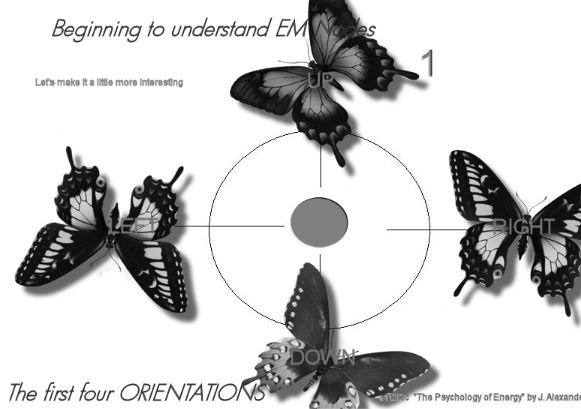
In this course the EM field refers to the "overall" energy field of a person. Whether that person is yourself or someone else, we all produce and "own" an EM field. This field has electromagnetic properties but our interest is in the EMotional field generated by people. Emotions are connected to mental states and mental states are connected to emotions.
There are eight primary Nodes in the EM field of every person. Remember my key axiom for Empath knowledge: "what you know about yourself, you know about everyone else." So I will primarily be referring to your own experience with the Nodes in order to make the information meaningful. Once you have understood how a principle works within yourself you can apply it others.
Throughout these lessons I refer to "circles". I use the word 'circle" to indicate holographic properties. Holographic properties may be actual or metaphoric; either way reflects the level of information we are accessing through this study.
For the purposes of this discussion Nodes are CIRCLES. Wherever you perceive or experience a circle you are perceiving or experiencing a node. Specific to the evolution of empathic intelligence, Nodes are conditions in the EM field of every person you meet. I realize this can sound very abstract at first but as you work with the concept through the lessons it will become more practical. States of consciousness, states of mind and emotion, are also abstract on one level but quite tangible on another. For instance, anger is a state of mind which means so many things to us. It implies all kinds of associations and ideas. Yet there are also physiological processes at work: electro-chemical changes that are specific to anger. Some states of mind are not so clearly defined in Neuropsychology and may be referred to as "meta-states." Eventually science will have every aspect of our "beingness" mapped out (?) but for now some parts of the human soul remain elusive. These meta-states are what I will refer to as "Nodes."
A little play on words will bring this into focus. A node is a mode. I realize that sounds a little like a Dr. Seuss(ism" but it works. More accurately, a node is the source of the mode. Whatever "mode" you are in indicates the "node" that is active. For example, you may be accustomed to hearing someone say "I was in survival mode." That statement actually refers to a group of conditions within the body and brain. The phrase survival mode is used more as a figure of speech, but there is an actual survival mode which is a reaction to a life threatening situation. There are also many degrees of survival mode. Survival mode can range from needing finances to get by, all the way to trying to get out of the path of a tornado.
What you are going to learn about here can be considered "pre-set" patterns within consciousness that affect thought, feeling, and behavior. Notice I say "consciousness", instead of brain. These pre-set patterns may or may not be based solely upon conditions within the brain. When I refer to consciousness I am referring to the "field effect" generated by the brain. It is entirely probable that the field effect has it's own dimensions, conditions, and unique functions. Within the field of consciousness there are eight unique pre-set patterns or Nodes. The model I developed to represent the study of these Nodes is called the "PHI model of consciousness." It is specific to teaching Empaths how to develop Empathic Intelligence to greater and greater degrees.
The PHI model of consciousness is a teaching tool used to train Empaths and to accelerate their development. This course will introduce you to a cursory glance of the PHI model and will assist you in transforming the model into practical tools and insights. You are actually learning the PHI model backwards, beginning with the pieces. The pieces will be all put together at the end of the sections on The Psychology of Energy.
Now, let's take what you learned in Dreamtongue and take that information to the next level!
The Eight Nodes
There are Eight dominant Nodes in the EM field. I will introduce those Nodes to you in small steps, so that you have the opportunity to have an expanded and in-depth appreciation of what is being referred to in this course by the word "Nodes."
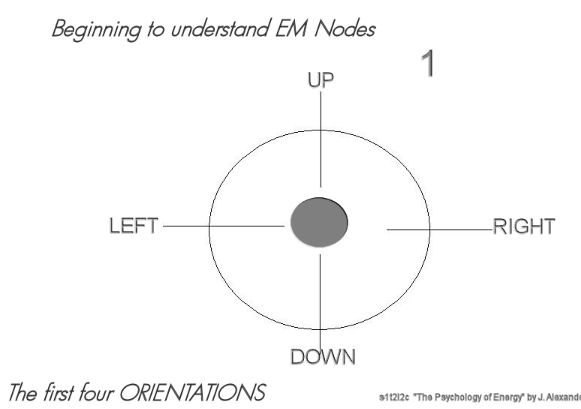
Everyone person has an EM field. You have an EM field. All living things have EM fields. More than likely, EVERYTHING has an EM field. But as Empaths our interest in primarily in living things, especially other people. The illustration above shows four basic orientations on a circle, which function as the orientations of the EM field, and therefore, the Nodes. Picture yourself standing in the circle, facing in, so that where it says "right", is your right and "left" is your left. The diagram (and all diagrams to follow, illustrate as the orientations as they would be, if you were facing another person.)
Nodes have a lot to do with orientation and context. Orientation to oneself, to others, to the physical world around you, to experience, to objects of perception, etc. Orientation is a very powerful concept to understand for expanding Empath awareness.
The illustration above shows the very basic levels of orientation that are based upon our own perceptual awareness. Up, Down, Left, Right. These four orientations are very familiar to us all and serve as a good starting place to begin to develop an understanding of Nodes. I am sure you understand that UP, Down, Right, Left, have no actual physical dimensions but are extremely real to our experience. Such is the nature of Nodes: they do not have any physical measurements but have profound impact on our lives, identity, and experience.
The four orientations fit into many parts of our experience and can be compared & associated with other related patterns. This will be expanded upon throughout the discussions on Nodes.
We are going to use the above illustration to walk step by step into an understanding of Nodes. The end result of this discussion will be quite wonderful as we will begin here but "come out" in the area of "Empath Types" which is of particular interest to anyone who took the quiz "What Type of Empath Are You?". Patience and thoroughness are key to learning here.
More Directions
So far we have looked at the first four orientations of Up, Down, Left, and Right. These seem obvious and simple enough.
The diagram we are using will ultimately evolve into the PHI model, so what we are doing is building the PHI model from scratch (in reverse)..
The first four node orientations can be understood in other terms such as directional and positional:
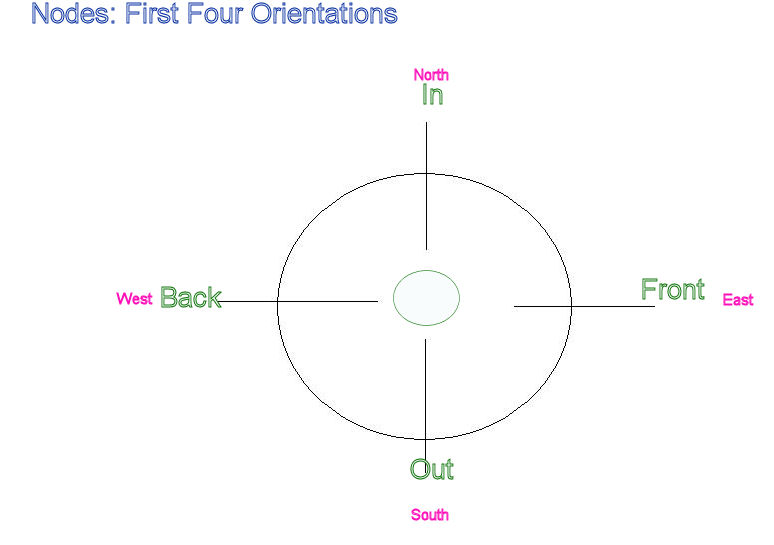
Now we want to tie the orientations together and relate them to what we learned in the Dreamtongue lessons.
The orientation of "OUT" (outer, outward) is equivalent to SOUTH or DOWN and is relative to BETA in Dreamtongue.
The orientation of "IN" (inner, inward) is equivalent to NORTH or UP and is relative to ALPHA in Dreamtongue.
The orientation of "FRONT" (ahead, before) is equivalent to EAST or RIGHT and is relative to THETA in Dreamtongue.
The orientation of "BACK" (behind, after) is equivalent to WEST or LEFT and is relative to DELTA in Dreamtongue.
If you are comfortable with the first four orientations (so far) then you are ready to learn the first four Nodes. I would recommend printing out the diagrams as we go and keeping them in a notebook. Don't worry about "memorizing' all the technical details of the Nodes. Once you are done with the study you will find that you will have an intuitive grasp of the Empath Map (PHI Model) that will be more important than an "academic explanation."
As I mentioned in earlier , I strongly recommend reading the "Holographic Universe" by Michael Talbot. There are many benefits to reading that material. Of particular interest to us here is the concept of an "interference pattern." The EM field we are learning about is a type of interference pattern, having similar functions and properties. The concept of interference pattern serves as an important metaphor in later advanced parts of the study.
More About The First Four Nodes
Now that you have an idea of the four orientations, you are ready to learn about the actual Nodes. Nodes occur within the EM field any time a particular "area of thought" dominates a person (a person's mind). There are four fundamental "areas of thought" which originate from deep within your being, your mind/body, your central nervous system, and essentially, your genetics.. These "areas of thought" or matrices shape how you and everyone else thinks, feels, and behaves. When one of these matrices are active/dominant in a person's EM field it becomes a "NODE." On the creative side, I like to call these Nodes "innergies," but will stick to Nodes for the sake of the lessons.
Nodes appear and disappear on a constant basis. They can "appear" in any of the orientations and can shift in a fluid manner at any given point in time. So think of the diagram as representing a powerfully "gyroscopic" process..
Now, let's begin with a general overview of the Nodes and the pattern at work behind the node. I recommend drawing your own diagrams as you follow along with the lesson. Use the illustrations to assist you.
Node 1
Kinetic Ontology (K.O.)
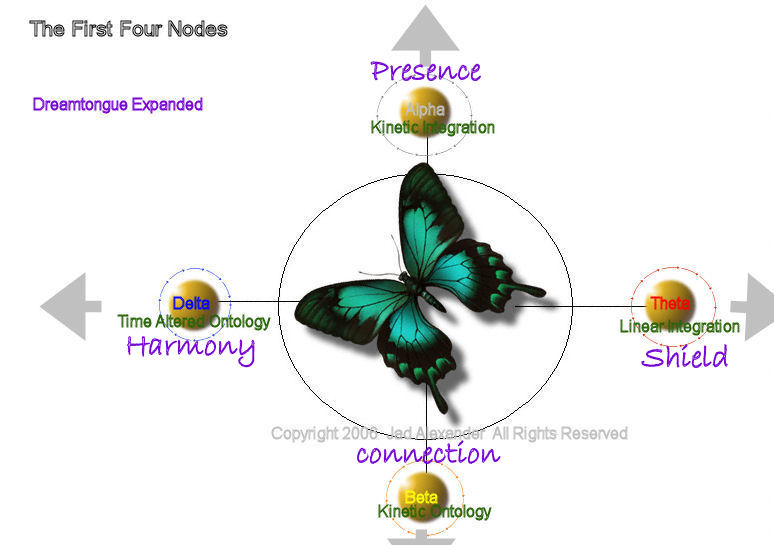
Node 1 (first position) begins in the "OUT" or outer orientation of the EM field. This is simpler than it sounds when you remember that the "OUT" position refers to BETA, so you know immediately that Node 1 is related to physical conditions, states, and behaviors. To be more specific Node 1 (or the Beta Node) is oriented towards physical well-being and safety. When the Beta Node is active/dominant you are oriented towards survival, physical necessity, and existing. In the west, the U.S., so much of life is "cushioned" and "prepared" for us that we do not feel the crunch of survival as much as primitive man and woman. Sadly, this is not true for all countries of the world. We no longer are required to hunt for our food or fight off wild animals to survive. Instead, we good to the grocery store and are required to get along with our neighbors. Still, the survival node exists within us and shapes our behaviors "behind the scenes," so to speak. In your modern life, the issue of money and financial well-being is most likely to trigger your Beta Node. Even more important: we can thank the Beta Node for intuitions regarding danger, threat, and safety issues. It's primary function has become that of a "Connector" node, seeking to Connect with and understand what it is we are connecting with overall.
Node 2
Kinetic Integration (K.I.)
Node 2 (second position) begins in the "IN" or inner orientation of the EM field. This is also simplified by remembering that the "IN" position refers to ALPHA. See how this is going to work? Node 2 is related to emotional/mental states and activities. Node 2 or the Alpha Node is oriented towards emotional positioning in relation to the environment and "others." The Alpha Node displays your reactions and responses to everything around you, how you perceive it, and what you feel about it. At the very base of the Alpha Node is the need to own thing, possess something, control it, to have personal power, and have it available to you to fulfill your needs. In this sense the Alpha node makes you territorial and in need of status and power. The Alpha Node determines if you are passive or dominant, aggressive or compliant, etc. The Alpha Node is probably what you are the most sensitive to as an Empath. When you get "hit" with a strong emotion from another person, you are in effect "bumping" into their Alpha Node. Once you fully understand Nodes you will also understand how to work with them and deal with their impact.
Node 3
Linear Integration (L.I..)
Node 3 (third position) begins in the "FRONT" or forward orientation of the EM field. This position refers to the THETA level of Dreamtongue, so you should immediately associate the Theta Node with "thought" (as a separate function from emotion) mind, intellect, language, symbols, and tools. This is the intellectual node, no matter what the configuration of the intellect might be. Intelligence of all forms is shaped here: I.Q., in the traditional sense, but even more. We now understand that there are multiple forms of intelligence, such as musical, spatial, social, emotional, etc. When you are engaging someone in a thoughtful or intellectual conversation (of any level) you are engaging the Theta Node of that person. The Theta node reveals a great deal about us. Since the Theta node is where (and how) you organize information, great quantities of information are available here to be "read" by an Empath. Once I have given you the "label" or name of this Node, you will see it's functions from a deeper perspective.
Node 4
Time Altered Ontology (T.A.O.)
Node 4 (fourth position) begins in the "BACK" or behind orientation of the EM field. This position refers to the DELTA level of Dreamtongue. The Delta Node is where experience and Self are integrated into groups and collections, and even gestalts. The Delta Node is somewhat of a memory bank, and so, is the "wizard behind the curtain" within your psyche. I realize that is an odd analogy to throw out right now, but think about it. Apart from it's core functions the Delta Node directs the relationships you have in your life. Relationships with family, friends, lovers, peers, co-workers, neighbors, strangers, and society as a whole. It is where you fit in socially and interpersonally in your own life. As you might suspect, this is a node of special interest to us all, as for the most part it remains a mystery to many.
Think on these things for awhile. Print or draw out the diagrams that I have provided. Let your self feel the "intuitions" generated by the diagram and relationships between the Nodes/orientations. In meditation, these can provoke profound insights. Take time to work with this material, when you are ready we will go deeper INTO this subject.
Copyright 2006 Jad Alexander All Rights Reserved
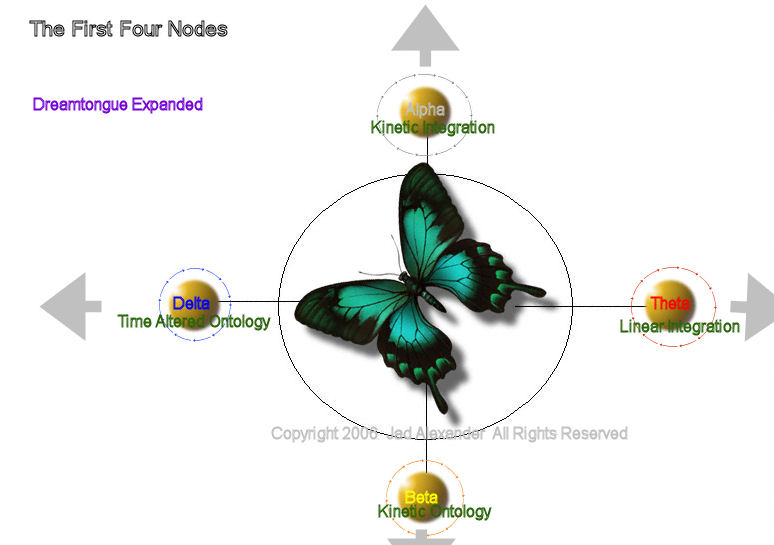
Let's talk about Nodes! Our goal is to make them tangible and understandable. I say "our" goal because I am relying on you to take time to study and question as you go along. Once we have done that, you will get closer to being able to read and work with Nodes.
Once you are adept with Nodes you will be able to :
All of the above mentioned skills mature over time and improve with experience, so be patient with yourself.
Nodes occur wherever two "energies" intersect. Nodes exist within you as potentials and Nodes form when you interact with others. These "energies" can be actual (with physical dimensions) or abstract. Abstract energies reflect processes that we can grasp with our minds but cannot measure with any type of machinery. Being able to sense, read, and work with these Nodes is at the core of being a trained Empath in these studies.
The first thing we want to do is to make our understanding of the Nodes "user friendly." We don't really need long words like "kinetic ontology," although it is good to have available for future reference. So let's look at some user friendly terms for the Nodes.
Once you have a working knowledge of the Nodes, you will not need to refer to the "node" part; you will be able to discuss or understand someone's "Connection, Presence, Shield, or Harmony."
(Note: remember throughout the courses, we are discussing concepts with "holographic properties." This means that each node also reflects every other node. In other words, every node has a "connector", a "presence", a "shield", and a "harmony" factor. This will apply in the advanced section of the course.
Here are the first four Nodes with their respective "user friendly" labels:
When you are ready to go further in your study of Nodes click here
© 2006 Jad Alexander All Rights Reserved
